
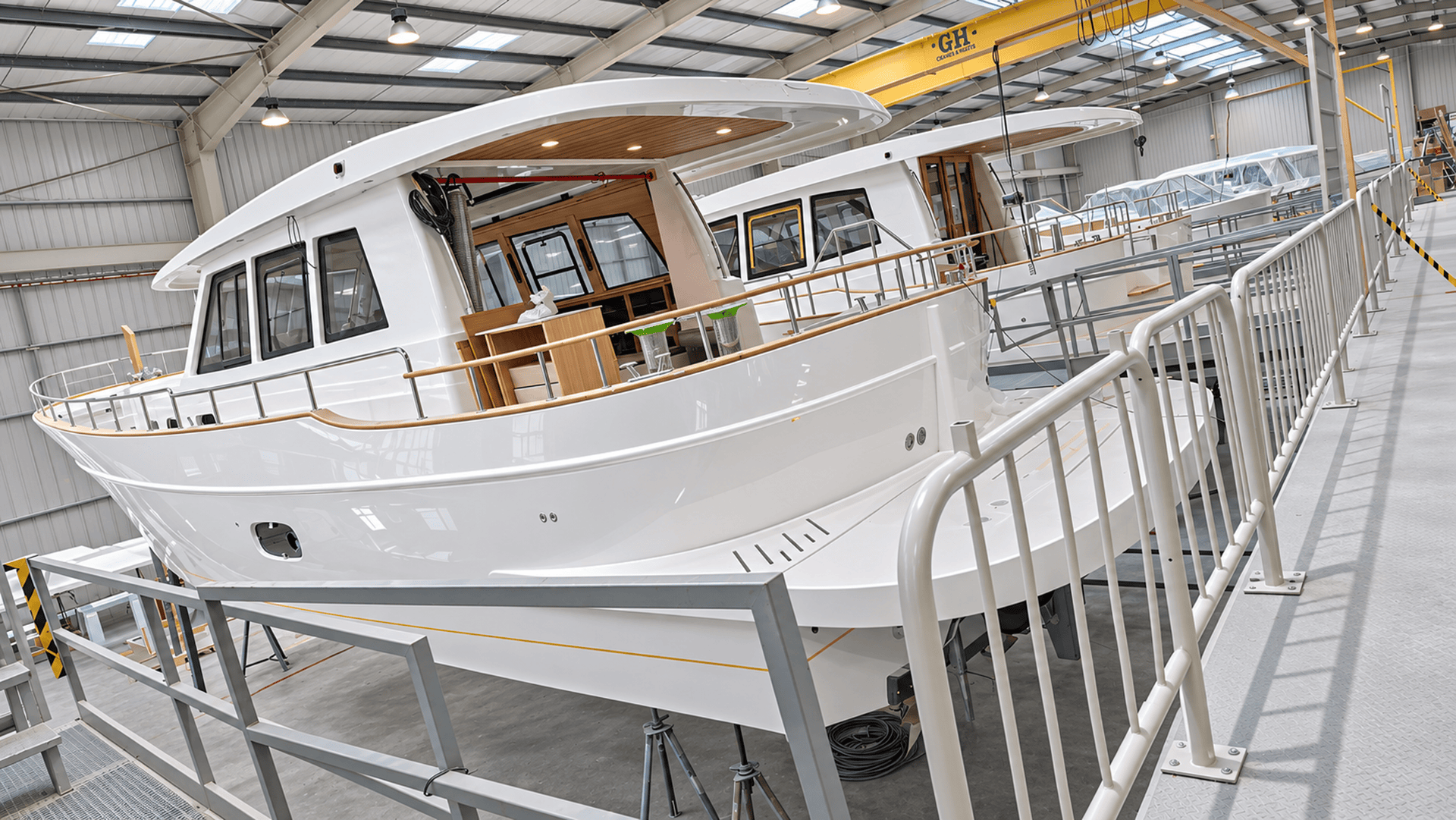
Anyone stepping aboard a Menorquín for the first time will notice the woodwork, the cockpit and the saloon finishes. These are the things you can see. What you can't see is how much resin has gone into the hull, how low the batteries are positioned or where the fuel tanks are located. Yet these are the details that determine how the yacht behaves as soon as it leaves the harbour.
When building a Menorquín, weight is addressed in two stages. First, making sure the yacht contains exactly the materials it needs, and nothing more. Then, ensuring every kilogram is in the right place. In the end, the sea will put that work to the test.
First, Getting the Weight Right When Building a Menorquín
The hull and deck are manufactured using vacuum infusion. Dry fibres are laid into the mould, covered with an airtight bag and the air is extracted. Once the vacuum is established, resin flows through a network of carefully planned channels, evenly impregnating the laminate.
In hand lay-up, resin is applied with a roller, and the amount used depends largely on the person doing the laminating. With vacuum infusion, the fibre-to-resin ratio can be controlled more precisely and maintained consistently from one component to the next.
The strength of the laminate comes mainly from the fibres. The resin binds them together and distributes the loads, but any excess resin adds unnecessary weight. In a component as large as a hull, that extra weight quickly adds up. Vacuum infusion also reduces air bubbles and areas where the fibres are not properly impregnated, both of which are weak points in any laminate.
Much of the hull and deck uses sandwich construction: two skins of fibreglass and vinyl ester resin separated by a lightweight core. By keeping the skins apart, the panel gains considerable stiffness with very little additional weight. It's the same principle that makes an I-beam stronger than a solid bar of the same weight.
There is a limit to weight reduction, of course. The engine mounts, structural reinforcements and attachment points for the anchor windlass, cleats and bathing platform are subjected to repeated loads over many years. In these areas, the laminate is deliberately thicker. Each part of the structure contains exactly the amount of material needed to withstand its loads, no more and no less.
Then, Every Kilogram in the Right Place
Two yachts with the same displacement can behave very differently at sea. It all depends on how their weight is distributed.
During the design process, the weight and position of everything on board are recorded: the structure, engines, tanks, batteries, generator, furniture, appliances and air conditioning equipment. This information is used to calculate the yacht's centre of gravity, both along its length and vertically.
Heavy equipment has the greatest influence on the centre of gravity. Moving a generator or a battery bank just a few centimetres can change the yacht's trim, or its fore-and-aft inclination. Height matters too. A kilogram on the flybridge weighs the same as one near the bottom of the hull, but it has a much greater effect on stability. That's why, on flybridge models, particular attention is paid to the furniture, helm console and upper structure.
Wood deserves a section of its own. A Menorquín features extensive woodwork, both inside and out, and it is part of what makes these yachts so recognisable. For the naval architect, that wood represents weight, just like any other material. It stays because it is part of the yacht's identity, but its weight is accounted for from the very first drawings rather than added at the end.
There is another complication: a yacht's weight changes while cruising. Fuel is consumed, the freshwater tank empties, six people come aboard with their bags, and the fridge is stocked for the weekend. A cruising yacht needs to perform well with full tanks on Saturday morning and half-empty ones on Sunday afternoon.
That's why the tanks are positioned as close as possible to the centre of gravity. This way, as they go from full to empty, the yacht's trim changes very little. The same principle applies to batteries and other heavy equipment.
The Real Test, at Sea
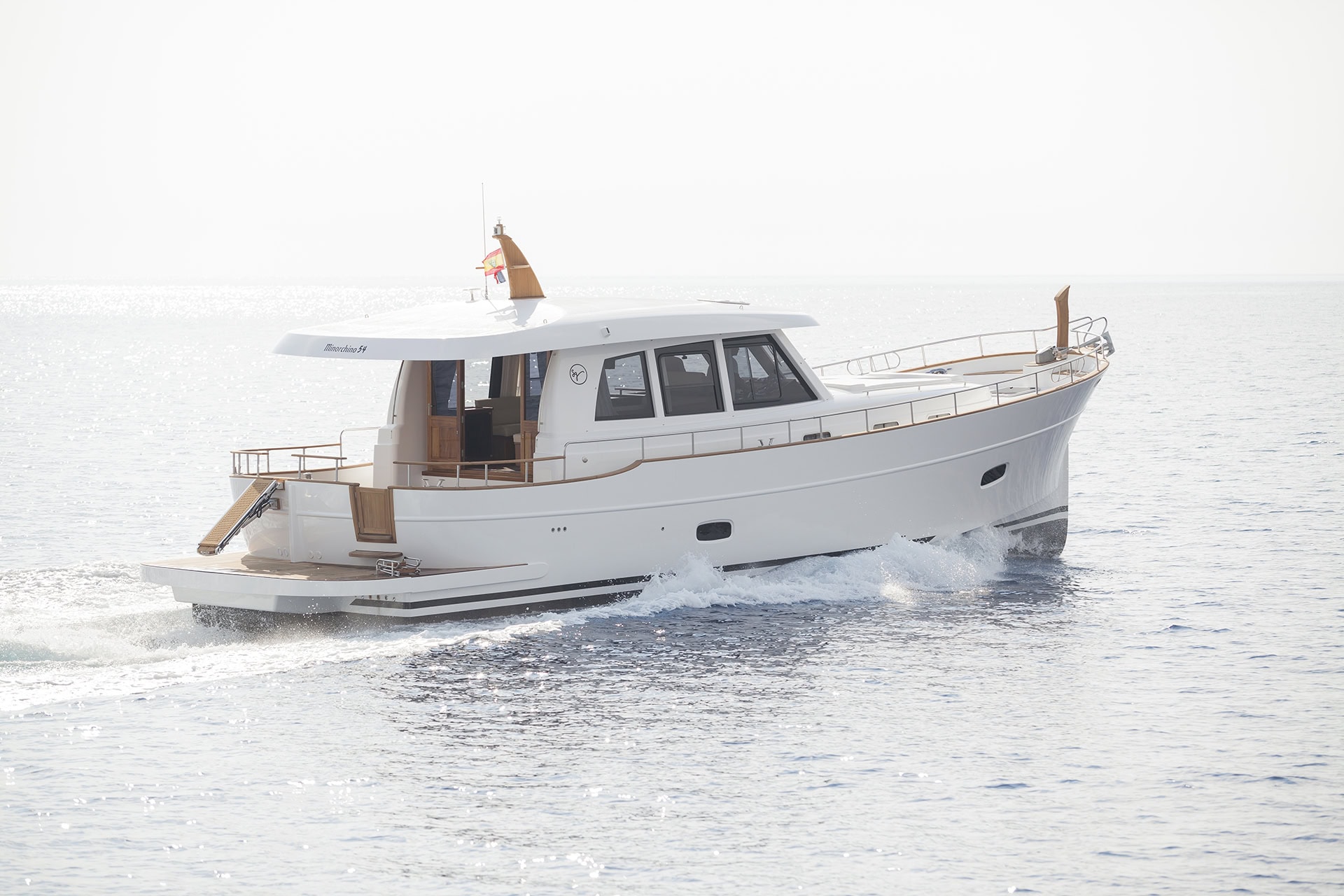
All of this is put to the test during sea trials. Speed and fuel consumption are measured at different engine speeds, along with trim, steering response and the yacht's behaviour in waves.
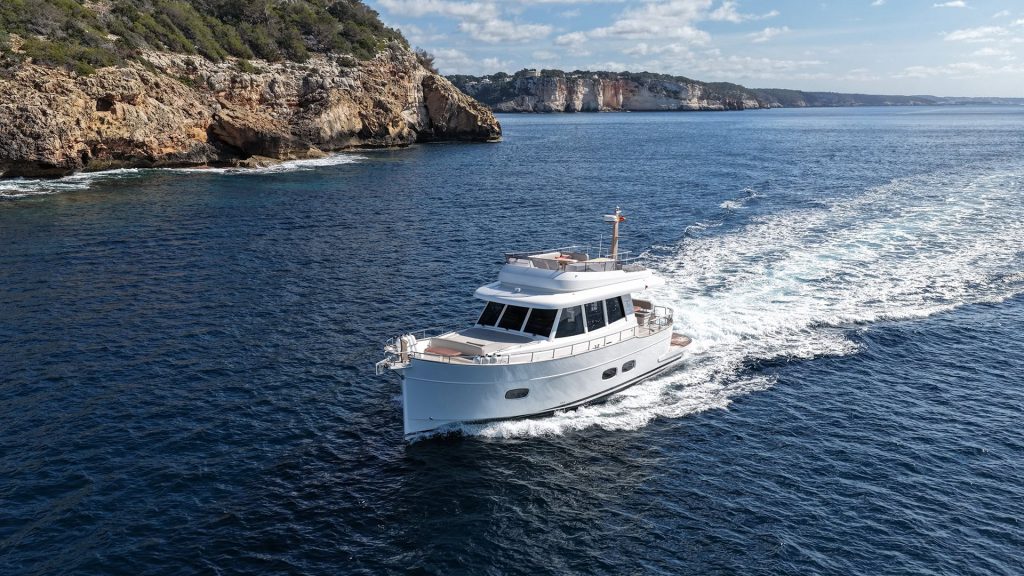
A well-balanced yacht cruises with its hull at the attitude it was designed for. If the bow rides too high or too low, the hull creates more resistance as it moves through the water. More power is needed to maintain the same speed, which means higher fuel consumption. Weight distribution also affects pitching, how the yacht meets the waves and how quickly it responds to the helm.
The owner won't be thinking about the resin ratio while at the helm, or where the centre of gravity lies. What they'll notice is that the yacht holds its course without constant corrections, meets the waves smoothly and behaves consistently whether the tanks are full or half empty.
Almost none of this is visible once the yacht is finished. But you can feel the difference as soon as you cast off. That's the key to building a Menorquín.
 Spanish
 English
 German
 Italian
 French