
The question that truly defines a boat
There is a question that rarely comes up, and it is almost never “efficiency at sea” when someone is considering buying a boat. It does not appear in brochures, it rarely emerges in the first conversation with the salesperson, and yet, over time, it becomes the only one that truly matters.
It is not about how many knots it can reach, nor the installed power, nor the metres of length. The question is another one, simpler and far more revealing: how long can an owner navigate before the boat itself starts to condition them?
Because there are designs that, after a few hours, cease to be an instrument of freedom and become a responsibility. And that transition, which no one announces in the technical specifications, is exactly what separates a boat designed to impress from one designed to navigate.
The nautical industry has spent decades building its discourse around power and top speed. It is an argument that works well at first glance, when figures seem sufficient to explain how a boat behaves. The problem is that those numbers are calibrated for specific moments, not for real-world use. Most time on the water is not spent at top speed, but at cruising speed, in those intermediate ranges where design efficiency truly makes the difference, even if that cannot be seen or photographed at the dock.
Where efficiency at sea is truly determined
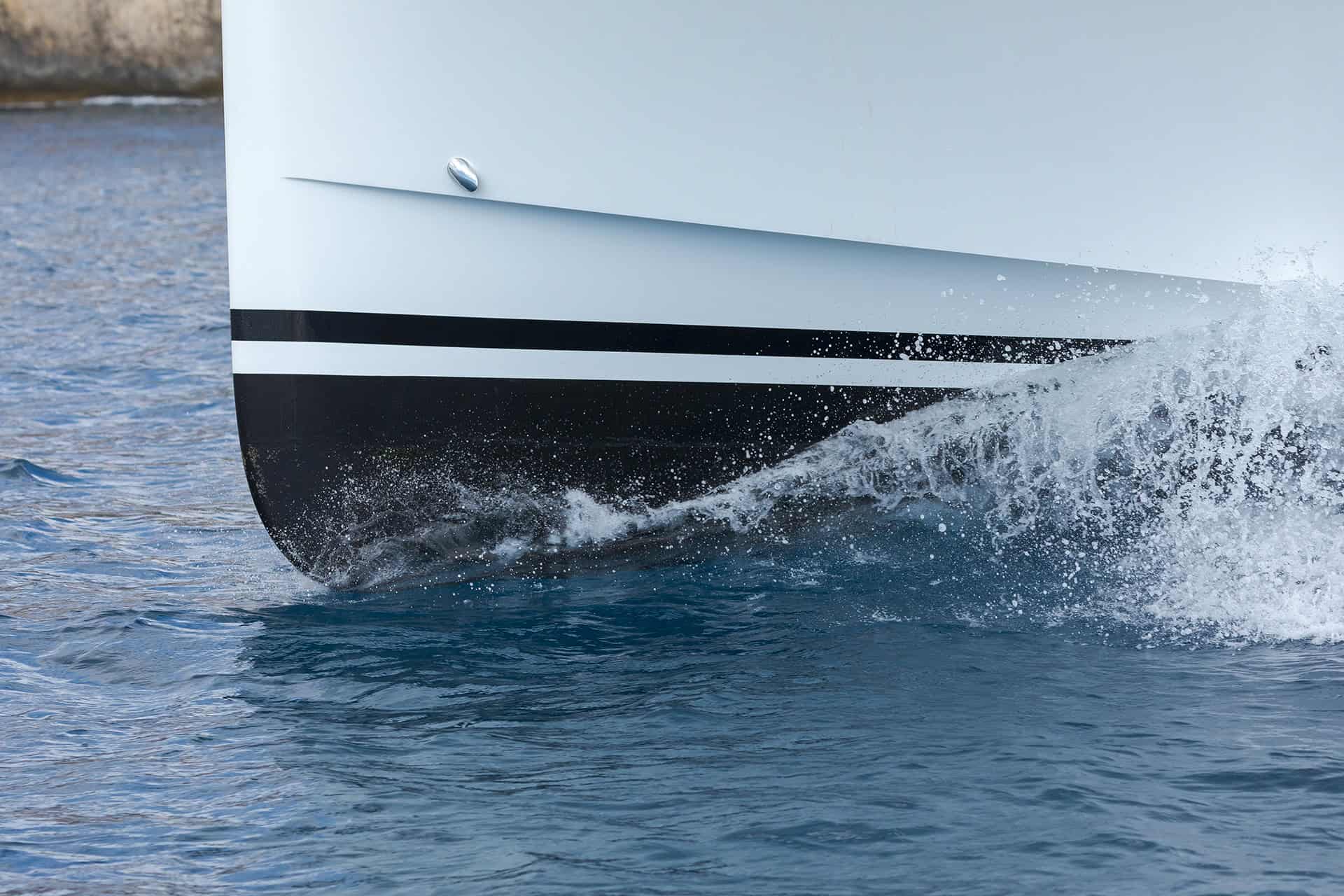
Sustained navigation above 25 or 30 knots has direct consequences for fuel consumption, the structural stress on the hull and real-world range. The increases are not linear. They are exponential. And a design conceived solely to reach a maximum figure often pays that price during all the hours in which it is not reaching it. That is where efficiency at sea begins: before the engine, before the electronics, before any equipment, there is the relationship between the hull and the water. That is where almost everything else is decided.
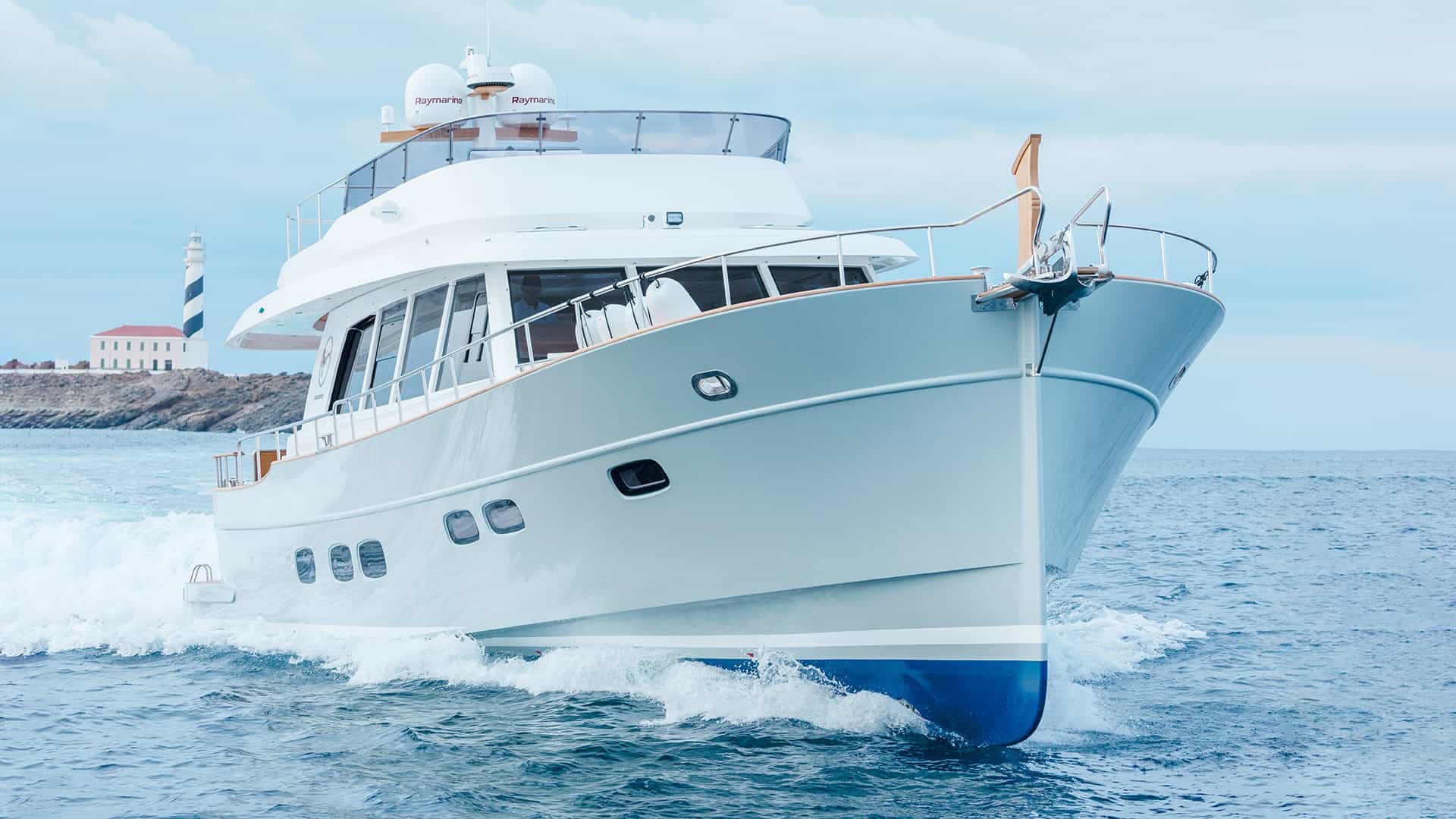
The semi-displacement hull is not a compromise solution, nor an outdated technology. It is a precise technical response to a specific question: how to make a boat navigate efficiently for hours, not for minutes. Stable cruising speeds of around 18–20 knots, top speeds close to 22–23, and a behaviour that does not penalise performance or comfort as the miles go by. What distinguishes this approach from an equivalent planing hull is not only the fuel consumption figure. It is that this performance is maintained. It does not degrade over time, nor does it worsen when the sea picks up. On land, fuel consumption is a variable within a budget.
The difference that appears with the hours
At sea, it is a boundary. It determines how far one can go, with what margin decisions can be made when the weather changes, and how long a boat can remain on the water before depending on a refuelling point.
An efficient design does not eliminate that boundary, but it shifts it far enough for it to stop being a constant concern. And that difference at sea, which on paper may seem small, radically changes the relationship between the owner and their boat.
There are owners who plan their passages according to the fuel available. There are owners who plan them according to what they want to see. The difference between one and the other is not always experience or budget.
Often, it is simply the boat. After three or four hours of navigation, any boat begins to reveal what it truly is: the accumulated fatigue, the physical effort required to maintain posture, to compensate for movement, to process the constant noise of the engine. That, too, is efficiency at sea.
It is not measured in litres per hour or in top-speed knots. A well-resolved design reduces all of that. It does not eliminate it, but it reduces it. And at the end of a long day, the difference is felt in a way that needs no explanation: there is no sense of having fought against the boat to arrive. The boat has done what it was meant to do, and the owner has been free to sail.
It may seem like a minor distinction, but it is not. It is exactly the difference between a boat designed for the first day and one designed so that the twentieth day on the water is just as good as the first. That does not appear in the catalogues, but it is the only thing that truly lasts.
 Spanish
  English
  German
  Italian
  French